


 Posts



May CAREGiver of the Month
Wednesday, June 30, 2010
Congratulations to Eva Richardson. She was selected as CAREGiver of the Month for May!


Lack of Resources Will Leave Families, Employees Struggling to Care for Seniors with Alzheimer’s
Paul Hogan, the co-founder and CEO of Home
Instead Senior Care, appears in Corp! magazine, discussing the unique
pressures that families, employees and employers face in the light of
the rise in Alzheimer's disease. Click below to read more...
Lack of Resources Will Leave Families, Employees Struggling to Care for Seniors with Alzheimer’s
A Senior Home's Clutter Zones
Monday, June 21, 2010

KITCHEN
Cabinets with unused pots and pans.Problem: a senior can fall trying to get to them.
Freezer and refrigerator with the expired and old food.
Problem: a senior can suffer food poisoning or malnutrition.
Bills on the counter and kitchen table.
Problem: unpaid bills
BATHROOM
Expired medication in the medicine cabinets and old make-up.
Problem: missed medications and accidental overdosing; skin infections and irritations from expired make-up.
Cluttered shelves.
Problem: inability to locate necessities.
Using the bathtub to store papers.
Problem: hygiene.
BEDROOM
Paper and magazines on and under beds.
Problem: fire hazard
Too much clothing and shoes in the closet.
Problem: Confusion and disorganization.
STAIRWAYS
Magazines and shoes on the steps.
Problem: tripping hazard.
BASEMENTS
A catch-all for everything.
Problem: rodents, mold & mildew.
Book Tour
Monday, June 7, 2010
Home Instead Senior Care hosted a book tour event to educate individuals about "Stages of Senior Care", written by Paul & Logan Hogan, founders of Home Instead Senior Care.
The day started with a visit from Paul Hogan and other Home Instead staff from Omaha. There was a request for some Dreamland BBQ so we brought it in for lunch.
Thank goodness for bibs since ribs are not the smartest thing to eat right before an event!

Paul agreed that the bib was a good idea!

The Birmingham office enjoyed the ribs & BBQ too - especially the banana pudding!
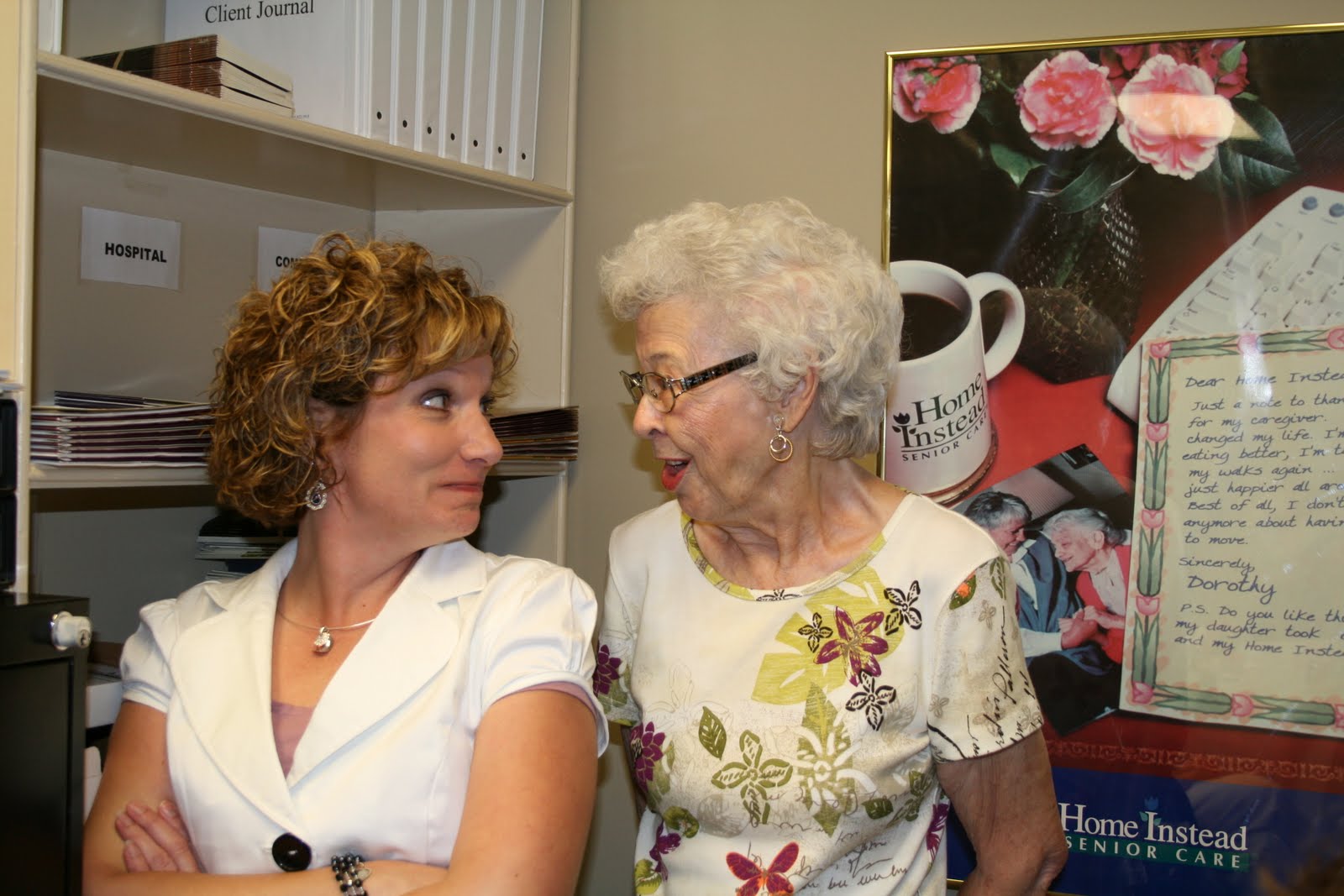
Dan's mom filling Holly {our performance coach from Omaha} in on Dan stories.

Dan & Paul before the event
After a great lunch we closed the office and headed to the B & A Warehouse to set up. Andrea Martin, our Assistant Operations Manager, worked closely with the B & A to ensure a great event.
Andrea surprised us with her flower arrangement ability!


Registration
Networking

Paul with Vance Holder & Sharon Ziemack

Jack Carney with Montgomery Home Instead owner Bill Purnell


Dr. Richard Allman greeted by Dan & Paul.
After about an hour of networking Paul began his presentation.

Paul explained who inspired him to start Home Instead Senior Care - Grandma Manhart.
15 years later and 40 million hours of care in 15 countries, Home Instead began to see trends effecting seniors. This trend was a lack of education and planning for their care.
Three challenges facing seniors and their adult children:
- First, they just don’t know about the care options or the cost of that care.
- Second, they don’t know who pays for what.
- And, finally, planning for senior care just isn’t a priority for them.
This lack of awareness and planning puts this generation at risk. This is why Paul and Lori wrote Stages of Senior Care.
Next, Paul shared with us what was learned about seniors and their loved ones when it comes to planning for care.
When asked in a survey to name unaided senior care options, here is what we learned:
- 71 percent of adult children could name only two senior care options;
- Seniors did even worse, with only two-thirds being able to name two care options;
- And, the two most cited care options were skilled nursing homes and assisted living centers – no surprise.
Most seniors and adult children STILL think Social Security, Medicare or their parents’ retirement accounts will cover the cost of care.
Also, in terms of assets available to pay for care, here are the facts:
- Two-thirds of seniors have assets valued at less than $75,000
- 41 percent have assets of less than $20,000.
- 75 percent of seniors have annual incomes of $36,000 or less
- 40 percent have annual incomes below $12,000
73% of adult children have neither planned nor thought about care.
Only 1/2 of seniors have planned or thought about developing a care plan for themselves.
Basically what we have found out about seniors and adult children:
- They do not understand senior care options.
- They don’t have a realistic grasp of the costs.
- They’re making a dangerously wrong assumption that government programs will pay for their care.
- Seniors are in no position to fund their own care.
- They have not planned for senior care.
YIKES!
Stages of Senior Care addresses all of these issues and more.
There used to be only 3 options for seniors.
- Stay in their own home
- Move to your home
- Move to a nursing home
Now there are more options for seniors - what many call the Continuum of Care:
- Aging in place
- Family care
- Senior centers & adult care centers
- Nonmedical care at home
- Medical care at home
- Retirement & independent living communities
- Assisted living
- Skilled nursing home
Paul also discussed resources to help you in the discussion of planning for care. We have a great website - 4070talk.com to help with this.
Ten Signs of trouble - recognizing when help is needed:
- Household bills piling up
- Reluctance to leave home
- Losing interest in meals
- Declining personal hygiene
- Declining driving skills
- Scorched pots and pans
- Signs of depression
- Missed doctors’ appointments and social engagements
- Unkempt house
- Losing track of medications
As you can see Stages of Senior Care is a great resource.
If you were unable to attend our event we have great handouts we can send you.
Please call us at 822.1915 or visit our website at www.homeinstead.com/bham
What Causes Hip Pain and How Can I Cope? A Free Seminar For Seniors
Thursday, June 3, 2010
what causes hip pain and how can i cope?
a free seminar for seniors
“This topic should be helpful to a majority of our community members as most seniors have dealt with hip pain or care for someone who does,” said Vonceil Sanders, manager of senior programs and services for Baptist Health System. “We hope to shed light on how individuals can cope with this ailment in order to improve the overall health of the seniors in our community.”
The event is free but registration is required. To register or for more information, please contact Sanders at 1-800-450-5099 or by email vonceil.sanders@bhsala.com.
*Information on how to obtain FREE CEU’S will be available for nurses, case managers, social workers and occupational therapist, compliments of Philips Lifeline.
###
About Senior Choices - Senior Choices is a membership program for people age 50 and older and is sponsored by the Baptist Health System. A wide variety of benefits, discounts and services that promote health and wellness are available to Senior Choice members. For more information, call toll free 1-800-450-5099 or visit Senior Services online at www.bhsala.com.
About Baptist Health System - Baptist Health System, Inc. is one of the largest health care systems in Alabama Alabama
How to Decide if an Assisted Living Facility Is a Good Fit - US News and World Report
Friday, May 28, 2010
How to Decide if an Assisted Living Facility Is a Good Fit - US News and World Report
With input from Home Instead Senior Care's Paul Hogan.
With input from Home Instead Senior Care's Paul Hogan.
Cute Quotes From Clients
Monday, May 24, 2010
When we asked a client if she was comfortable with her CAREGiver, she said,
"I'll adopt her. I want her all to myself."
Another client, when asked the same question, said,
"I would giver her a million dollars if I had it."
We have the sweetest clients and the best CAREGivers!!!
"I'll adopt her. I want her all to myself."
Another client, when asked the same question, said,
"I would giver her a million dollars if I had it."
We have the sweetest clients and the best CAREGivers!!!
10 Reasons Seniors Hang On To Stuff
Friday, May 21, 2010
10 Reasons Seniors Hang On To Stuff and What To Do About It
Following, from Home Instead Senior Care and Vickie Dellaquila, certified professional organizer and author of “Don’t Toss My Memories in the Trash,” are 10 reasons seniors can’t or won’t give up their stuff and what to do about it.
1. The sentimental attachment. The beloved prom dress represents the history and memories of the event; it’s not the dress itself. Save only a piece of the dress to make a quilt or display in a shadow box. Scrapbooking and converting photos to DVDs are other ways to save treasured keepsakes without all the extra mess.
2. The sense of loyalty. Older adults who’ve received gifts from family and friends may be reluctant to part with them. Encourage your loved one to give unused gifts back to the giver or grandchildren.
3. The need to conserve. Seniors are the original green people. Appeal to a senior’s desire to help others. Counter a senior’s inclination to conserve by appealing to their desire to give back.
4. The fatigue. A home with a lifetime of memories can easily become too much for an older adult to handle. Help seniors manage clutter by establishing online bill paying. Also, get your senior off junk mail lists, which can put them at risk of identity theft, and buy them a shredder.
5. The change in health. Seniors who have suffered a brain trauma or stroke, who are wheelchair bound or who are experiencing dementia may no longer be able to manage household duties, which could contribute to clutter. If you see a health change, encourage your senior to visit his or her doctor and consider a professional organizer and caregiver to help your loved one.
6. The fear. Seniors often fear what will happen if they give up their stuff, like the older adult who saved three generations of bank statements. Use logic and information to help seniors understand it’s O.K. to let go.
7. The dream of the future. Those clothes in the closet don’t fit anymore, but your loved one is sure that some day she’ll lose enough weight to get into them. Ask seniors to fill a box with clothing they don’t wear much and make a list of the items in the box. Agree that if they have not gone back to the box in six months to wear the item, they will donate that to charity.
8. The love of shopping. Today’s seniors have more money than any other previous generation of older adults and they love to shop. Clutter can become so bad seniors can’t find things and they repurchase items they already have, contributing to the clutter cycle. Try to convince seniors to cut back and to say “no” to free stuff.
9. The history and memories. Keepsakes represent history and memories. Encourage seniors to take old photos to a family reunion and share with several generations. Let seniors know they can contribute to the history of their time and leave a lasting legacy by donating to museums and historical societies, a theater and library, or churches and synagogues.
10. The loneliness. Stuff can become a misplaced companion. Loneliness may also lead to depression, which makes it difficult for seniors to get organized. Consider the services of a professional organizer and caregiver.
For more information, go to the National Association of Professional Organizers at www.napo.net or visit www.homeinstead.com. Other experts contributing to these tips include Katherine “Kit” Anderson, CPO-CD, president of the National Study Group on Chronic Disorganization; University of Kansas Professor Dr. David Ekerdt, who is coordinating a “household moves” project to determine the role that possessions play in older people’s housing decisions; and University of New Mexico Researcher Dr. Catherine Roster.
Senior Driving: Safety Tips, Warning Signs, and Knowing When to Stop
Wednesday, May 19, 2010
Senior Driving
Safety Tips, Warning Signs, and Knowing When to Stop
Driver safety is an important and often sensitive issue for seniors. The changes of normal aging can sometimes interfere with the ability to drive. Learn to reduce these risk factors. Drive safely longer by taking care of your health and incorporating safe driving practices. However, safety must come first. If you need to reduce your driving or eventually give up the keys, it doesn’t mean the end of your independence. With help from family, friends, community resources, a positive outlook, and personal action, you can remain mobile without driving.
Facts about driving and aging
Everyone ages differently, so some people can continue to drive into their seventies, eighties, and even beyond while others cannot or should not. However, the statistics on older adults and driving can be sobering.
Older adults and accidents
Statistics show that the elderly are more likely than other drivers to receive traffic citations for failing to yield, turning improperly, and running red lights and stop signs—all indications of decreased driving ability. It is a fact that older adults are at higher risk for road accidents than other age groups. Older drivers are more likely to get into multiple-vehicle accidents than younger people do, and the accidents are more dangerous for them than for younger drivers. A person 65 or older who is involved in a car accident is more likely to be seriously hurt, more likely to require hospitalization, and more likely to die than younger people involved in the same crash. Truth is, fatal crash rates rise sharply after a driver has reached the age of 70.
Environmental factors
There are environmental factors as well. These affect people of all ages and include signs and road markings that are difficult to see or read, complex and confusing intersections, older vehicles that lack automatic safety features, and newer dashboard instrument panels with multiple displays. Such factors are often amplified in those seniors who experience a decline in their ability to drive, and become very risky. For all of these reasons, you want to stay alert to your own driving experiences and be willing to admit and discuss any difficulties and concerns with a relative or someone else you trust.
Lessening aging risk factors that affect safe driving
It is easy to overlook problems that develop slowly over time because we typically accommodate our daily activities to what we can comfortably do. Consequently, issues like vision or hearing loss, decreasing physical activity, growing forgetfulness, or the impact of prescription and over-the-counter drugs are hardly noticed. Any one or a combination of these conditions can make driving hazardous.
Decrease risks by taking control of your health
The most important and positive action you can take is to decrease the driving risks associated with aging. Do not wait until problems become serious. Tending to your health and well-being on a regular basis can help in your efforts to stay independent and mobile. The most common risk factors related to safe driving are listed below along with suggested steps you can take:
Helping yourself drive safely
Visual decline
Get eyes checked every year and make sure that corrective lenses are current. Keep the windshield, mirrors, and headlights clean, and turn brightness up on the instrument panel on your dashboard.
Hearing loss
Have hearing checked annually. If hearing aids are prescribed, make sure they are worn while driving
Limited mobility and increased reaction time
An occupational therapist or a certified driving rehabilitation specialist can prescribe equipment to make it easier to steer the car and to operate the foot pedals.
Medications
Talk with a doctor about the effects of medications you are taking on driving ability.
Drowsiness
Sleeping well is essential to driving well. If there are problems, try to improve nighttime sleep conditions and talk with a doctor about the effect of any sleep medications on driving.
Dementia and brain impairment
If there are any signs of dementia or brain impairment, limit driving and consult a doctor.
Please click here to continue reading the article
Difficulties of US Health Care Going Forward - CNBC.com
Tuesday, May 18, 2010
Home Instead Senior Care CEO Paul Hogan appears on CNBC to discuss the economic and social implications of caring for aging US population
Difficulties of US Health Care Going Forward - CNBC.com
Difficulties of US Health Care Going Forward - CNBC.com
BBA's 2010 Small Business Award Winners - Dan Pahos, Small Business Person of The Year!
Monday, May 10, 2010
2010 Small Business Award Winners
The BBA’s Small Business Committee recognized this year’s small business winners at an event Thursday, May 7, at B&A Warehouse. Here are the winners:
•Jesse J. Lewis – Mark Jackson, Moreson Conferencing
•Centennial – Brownell Travel
Nonprofit of the Year
•Category 1 – Southeastern Diabetes Education Services
•Category 2 – United Way Food Bank
•Small Business Advocate – James Little, Five Points South Merchant Group
Small Business Person of the Year
•Category 1 - Daniel Murray, Murray Building Company
•Category 2 – Lloyd C. Shelton, Lovoy, Summerville & Shelton, P.C.
•Category 3 – Dan Pahos, Home Instead Senior Care•
“My Choice” – The People’s Choice Award – Ruwena Healy, Marketing 24/7
We are so proud!
NY Times Article "More With Dementia Wander From Home"
Thursday, May 6, 2010
According to a NY Times article, "about 6 in 10 dementia victims will wander from home at least once, health care statistics show, and the numbers are growing worldwide, fueled primarily by Alzheimer’s disease, which has no cure and affects about half of all people over 85." — NYT
http://www.nytimes.com/2010/05/05/us/05search.html?ref=todayspaper
http://www.nytimes.com/2010/05/05/us/05search.html?ref=todayspaper
LEADING SENIOR CARE EXPERT TO HOST FREE PUBLIC SEMINAR IN BIRMINGHAM
Tuesday, May 4, 2010
Recent Study Shows Planning For Senior Care Out of Sight and Mind for Most Adults
BIRMINGHAM, Ala. -- Birmingham area seniors and their families are invited to attend a free seminar designed to explain the many care options available for today’s aging population. The seminar will be held Wednesday, June 2, 2010 from 4 p.m. -6 p.m. at the B&A Warehouse, 1531 First Avenue South. The featured speaker at the event will be Paul Hogan, co-author of the recently released book Stages of Senior Care: Your Step-by-Step Guide to Making the Best Decisions.
A leading senior care expert, Hogan will review a number important topics including: financial planning for senior care, being a caregiver to an elderly parent, insurance options, and the state of senior care in America.
“With more than 78 million Baby Boomers on the verge of retirement, America is facing monumental social and economic challenges in the ways in which we care for our seniors.” Hogan said. “If families are not prepared, navigating the care continuum can become a complex process that sometimes involves misinformation and injects unwanted stress into our most important relationships.”
A recent Home Instead Senior Care survey showed that planning for senior care is out of sight and out of mind for most adult children and seniors alike. In fact, half of all seniors ages 65 to 75 have not thought about their own future care needs, and nearly a quarter of 35- to 64-year-olds could not name a single senior care option available today. Even more startling: both seniors and adult children have the misconception that Social Security and Medicare will pay for senior care, while many are unfamiliar with the costs of today’s care options.
"Senior care options have expanded almost beyond recognition in the last 20 years, yet most Americans are still only familiar with nursing homes or family care at home," adds Hogan. “With tens of millions of Boomers starting to retire, it’s critical that people start thinking about this.”
Hogan’s book, Stages of Senior Care: Your Step-by-Step Guide to Making the Best Decisions serves as a comprehensive guide for the ever-expanding world of senior care, breaking down the process by addressing the shared concerns of seniors and their family members. Featuring more than 30 sources from the most credible major healthcare organizations, universities and nonprofit organizations, the book thoroughly explains each and every aspect of senior care, including the array of available care choices, being a caregiver, planning for your own future, aging in place, family and professional care options, how to chose an option and what to look for, financing care, insurance, legal matters, dealing with stress, communication and family relations.
Proceeds from the Stages of Senior Care will benefit the Home Instead Senior Care Foundation, which provides financial support of activities designed to improve the quality of life of seniors.
Reservations for the June 2 seminar can be made at www.stagesofseniorcarebirmingham.eventbrite.com or by contacting the local Home Instead Senior Care office at 205-822-1915. The first 50 guests will receive a complimentary copy of Stages of Senior Care.
Subscribe to:
Posts (Atom)